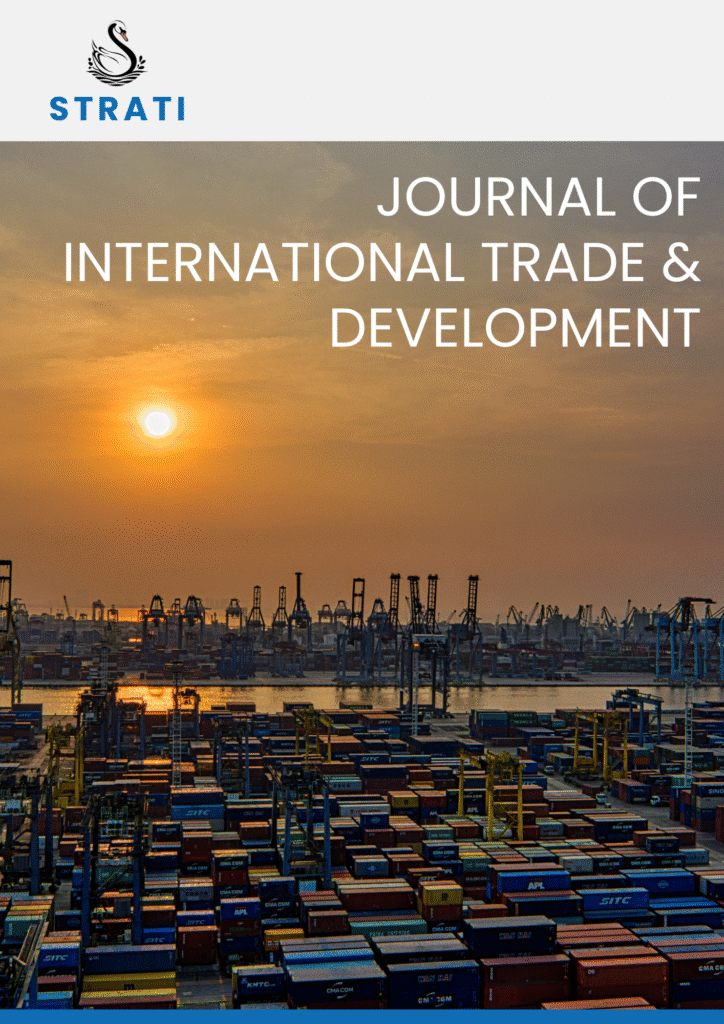
STRATI Journal of International Trade and Development

Home

Announcements

  • Expression of Interest
  • Aims and Scope

Journal Submission Guidelines

The STRATI Journal of International Trade and Development is an open-access, peer-reviewed international journal that provides a platform for high-quality research exploring the intricate relationships between global trade, economic development, and policy transformation. It encourages interdisciplinary and policy-relevant scholarship from academics, researchers, policymakers, practitioners, and institutional experts who work on trade theory and practice, development economics, global governance, and international cooperation.

The journal aims to deepen understanding of how trade influences development outcomes across income levels, regions, and sectors. It particularly welcomes empirical and theoretical work that investigates the dynamics of global value chains, regional integration, trade policy, market access, inclusive growth, technological diffusion, digital trade, and the Sustainable Development Goals (SDGs).

Contributions should typically be 6,000 to 8,000 words in length, accompanied by an abstract not exceeding 200 words. All submissions are subject to a rigorous double-blind peer review process. Authors must submit a plagiarism report at the time of submission in line with the journal’s zero-plagiarism policy. The journal seeks to ensure a review and decision timeline of no more than two months.

The journal caters to a global readership, including academic scholars, economists, trade negotiators, multilateral agencies, development professionals, and policy analysts seeking to understand and shape the interface between international trade and economic development.

The STRATI Journal of International Trade and Development seeks to advance scholarly and policy-relevant discourse on the role of trade in promoting sustainable and inclusive development. It provides a critical forum for addressing key questions around trade liberalization, protectionism, trade-related development strategies, and their economic, social, and environmental implications.

Its core mission is to explore the interplay between global trade policies and development outcomes—particularly in developing and emerging economies. The journal aims to publish innovative research on how international trade influences productivity, industrialization, poverty, inequality, structural transformation, and regional cooperation. Special emphasis is placed on trade-related reforms, institutional governance, trade and technology, digital trade, and the implications of multilateral and regional trade agreements.

Contributions from international economics, development economics, political economy, international relations, legal studies, and trade policy analysis are especially encouraged. The journal values both qualitative and quantitative approaches, including CGE models, econometric analysis, case studies, historical reviews, and normative policy analysis.

Detailed Themes

The journal welcomes submissions on (but is not limited to) the following broad and interrelated thematic areas:

  1. Theories and empirical analysis of international trade
  2. Trade and economic growth in developing countries
  3. Trade policy, tariffs, and non-tariff measures
  4. Trade liberalization and structural transformation
  5. Trade, poverty alleviation, and inequality
  6. Trade in services, intellectual property, and knowledge flows
  7. Global value chains and supply chain resilience
  8. Digital trade, e-commerce, and cross-border data flows
  9. Trade and climate change: carbon border taxes, green trade
  10. Trade and environmental sustainability
  11. Export diversification and competitiveness
  12. Regional trade agreements and economic integration
  13. South-South trade and triangular cooperation
  14. Trade facilitation and logistics infrastructure
  15. Foreign direct investment (FDI), technology transfer, and trade
  16. Inclusive trade policies for women, youth, and MSMEs
  17. International trade and food security
  18. Trade and employment linkages
  19. WTO reforms and global trade governance
  20. Trade-related aspects of the Sustainable Development Goals (SDGs)
  21. Rules of origin and preferential trade regimes
  22. Trade and industrial policy in emerging economies
  23. Impact of trade shocks, global crises, and pandemics
  24. Trade disputes, WTO litigation, and trade diplomacy
  25. Bilateral and multilateral trade negotiations
  26. Aid for Trade and trade-related development assistance
  27. Digital economy and trade in knowledge-intensive goods
  28. Geoeconomics, geopolitics, and trade alignments
  29. Trade finance, investment treaties, and development banks
  30. Trade ethics, labor standards, and sustainability certifications

Send your paper to Email: strat.institute@gmail.com

STRATI Journal of International Trade and Development” invites the university professors, researchers, and experts including experts based in government and non-government agencies and communities and members of civil society to serve as Editor(s), Sub-Editor(s), Guest Editors, Members on Advisory Board, and Peer Review Board in varied areas of scientific knowledge and expertise.

The expression of interest along with the Curriculum Vitae including a passport size and Google Scholar link can be sent to the Consulting Editor at E-mail: strat.institute@gmail.com