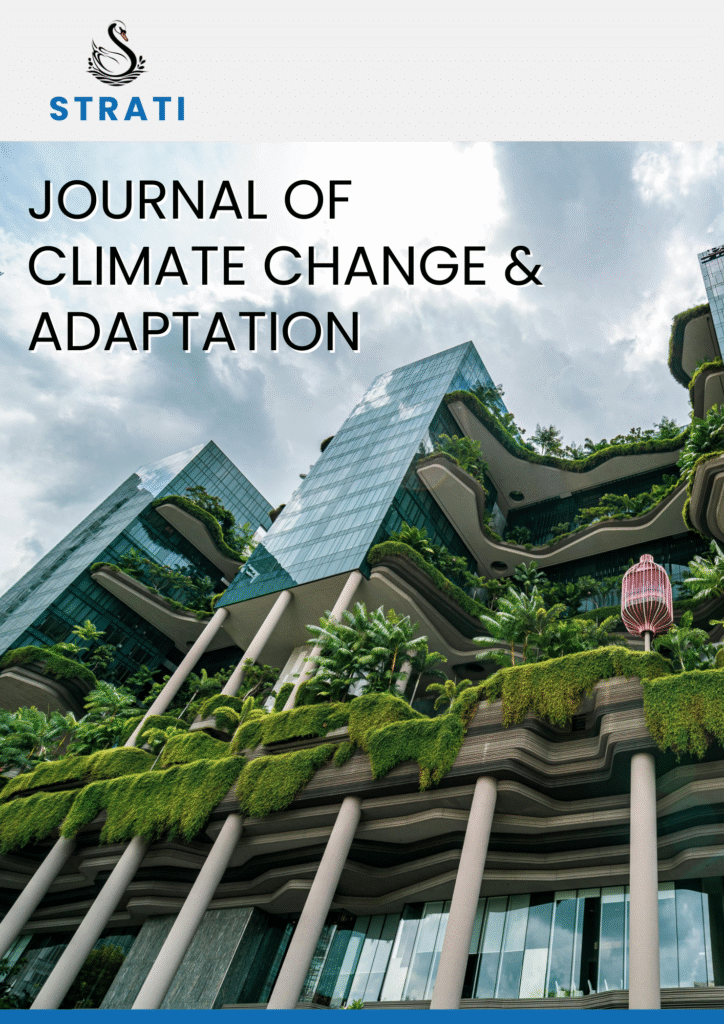
STRATI Journal of Climate Change and Adaptation

Home

Announcements

  • Expression of Interest
  • Aims and Scope

Journal Submission Guidelines

The STRATI Journal of Climate Change and Adaptation is an international, peer-reviewed, open-access journal dedicated to advancing scientific understanding, practical solutions, and policy innovation in climate change adaptation. Recognizing that climate impacts are already being felt across the globe, the journal serves as a platform for multidisciplinary and transdisciplinary research addressing how societies, economies, and ecosystems can anticipate, prepare for, and respond to climate risks.

The journal invites scholarly work that integrates climate science, environmental management, social and economic dimensions, governance structures, and technology applications to address adaptation challenges. By focusing on both local and global contexts, it bridges knowledge gaps between vulnerable communities, policymakers, researchers, and practitioners.

It aims to foster an evidence-based dialogue on resilience-building strategies that promote sustainable livelihoods, ecosystem integrity, and equitable climate action.

The Journal seeks to:

  • Promote cross-sectoral, interdisciplinary, and policy-relevant research on climate change adaptation.
  • Strengthen linkages between science, policy, and practice to enhance resilience in vulnerable systems.
  • Encourage innovative adaptation approaches that integrate social equity, environmental sustainability, and economic viability.
  • Support knowledge sharing for climate risk management and anticipatory action.
  • Provide a forum for comparative studies, regional assessments, and lessons learned from diverse adaptation contexts.

The journal welcomes empirical, theoretical, and methodological studies, case analyses, and policy reviews on adaptation in terrestrial, marine, urban, and rural systems.

Detailed Themes

Contributions to the journal may cover, but are not limited to, the following thematic areas:

  1. Climate vulnerability and risk assessment methodologies
  2. Sector-specific adaptation strategies (agriculture, forestry, fisheries, energy, water, health, etc.)
  3. Community-based adaptation and participatory approaches
  4. Ecosystem-based adaptation and nature-based solutions
  5. Adaptation in urban environments and resilient city planning
  6. Mountain and glacier-dependent community adaptation
  7. Small island and coastal adaptation strategies
  8. Adaptation for arid and semi-arid regions
  9. Integration of adaptation into national and local development plans
  10. Adaptation finance, investment mechanisms, and climate funds
  11. Insurance and risk-transfer mechanisms for climate resilience
  12. Climate-smart agriculture and food security under climate stress
  13. Water management and adaptation to hydrological changes
  14. Disaster risk reduction and adaptation linkages
  15. Public health adaptation to climate-sensitive diseases
  16. Migration, displacement, and planned relocation due to climate impacts
  17. Gender-responsive adaptation policies and practices
  18. Traditional knowledge and indigenous adaptation practices
  19. Monitoring, evaluation, and learning in adaptation projects
  20. Policy coherence between adaptation, mitigation, and sustainable development
  21. Resilience metrics and indicators for adaptation effectiveness
  22. Decision-support tools and modeling for adaptation planning
  23. Adaptive governance and institutional frameworks
  24. Interlinkages between adaptation, biodiversity, and ecosystem services
  25. Private sector engagement in adaptation and resilience building
  26. Regional cooperation for transboundary climate adaptation challenges
  27. Loss and damage mechanisms and post-disaster recovery strategies
  28. Scaling up successful adaptation pilots into policy frameworks
  29. Intergenerational perspectives in adaptation planning
  30. Synergies between adaptation and climate justice

Send your paper to Email: strat.institute@gmail.com

“STRATI Journal of Climate Change and Adaptation” invites the university professors, researchers, and experts including experts based in government and non-government agencies and communities and members of civil society to serve as Editor(s), Sub-Editor(s), Guest Editors, Members on Advisory Board, and Peer Review Board in varied areas of scientific knowledge and expertise.

The expression of interest along with the Curriculum Vitae including a passport size and Google Scholar link can be sent to the Consulting Editor at E-mail: strat.institute@gmail.com