STRATI Journal of Policy Research and Evaluation

Home

Announcements

  • Expression of Interest
  • Aims and Scope

Journal Submission Guidelines

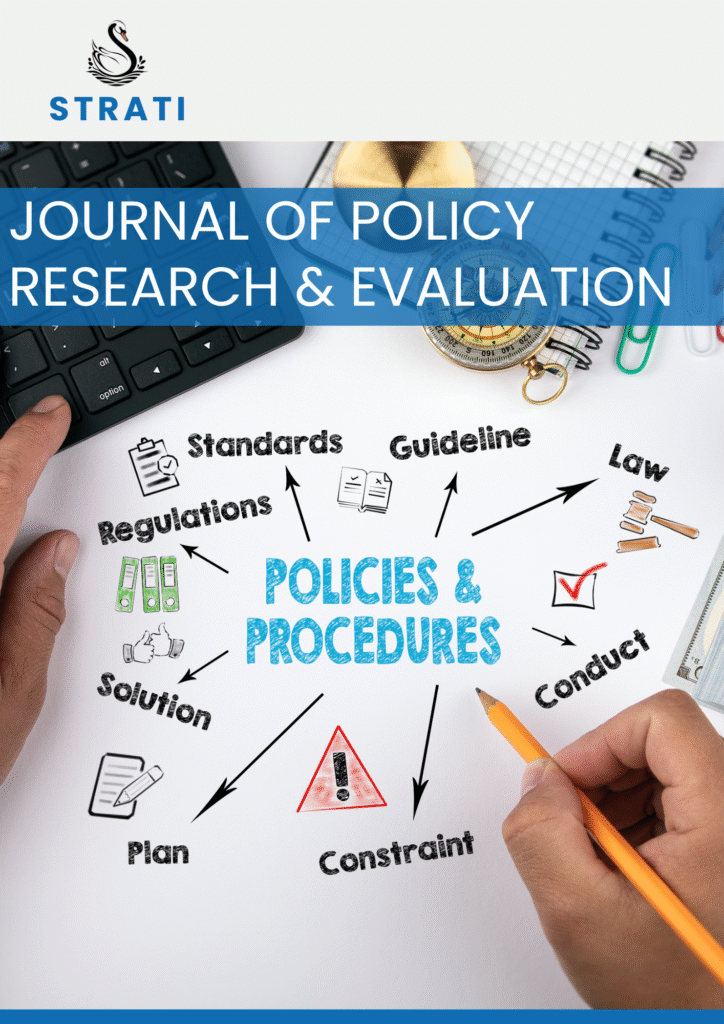
The STRATI Journal of Policy Research and Evaluation is an international, peer-reviewed, open-access journal dedicated to advancing the theory, methods, and practice of public policy research and program evaluation. The journal serves as a platform for scholars, practitioners, and policymakers to publish rigorous, evidence-based research that informs decision-making, enhances governance, and improves policy effectiveness at local, national, and global levels.

In a world of complex socio-economic, environmental, and technological challenges, the ability to design, implement, and evaluate public policy effectively has never been more critical. This journal provides a forum for interdisciplinary dialogue that integrates perspectives from economics, political science, sociology, public administration, law, international relations, and management, with a focus on developing robust frameworks for evaluating the real-world impacts of policy interventions.

It welcomes theoretical contributions, empirical studies, meta-analyses, comparative policy evaluations, methodological innovations, and case studies that examine policy formulation, implementation, monitoring, and evaluation processes.

The Journal aims to:

  • Advance academic and practical knowledge in policy design, research methodologies, and evaluation practices.
  • Promote rigorous assessment of policy interventions and their intended and unintended consequences.
  • Provide insights that enhance evidence-based policy-making and governance reform.
  • Encourage cross-disciplinary and cross-national perspectives in policy research.
  • Strengthen the link between academic research and policy practice by engaging scholars, government officials, and civil society stakeholders.

Scope includes (but is not limited to):

  • Policy formulation, design, and analysis.
  • Monitoring, evaluation, and learning (MEL) systems.
  • Impact assessments and cost-benefit analyses.
  • Governance and institutional capacity-building for policy implementation.
  • Comparative studies of policy effectiveness across sectors and regions.
  • Data-driven and participatory approaches to policy evaluation.

Detailed Themes

Potential areas of focus include, but are not limited to:

  1. Policy Formulation and Design – frameworks, models, and tools for effective policy development.
  2. Evidence-Based Policymaking – integrating scientific research, big data analytics, and real-time monitoring into policy processes.
  3. Program and Project Evaluation – methodologies for assessing effectiveness, efficiency, equity, and sustainability.
  4. Impact Assessment – social, economic, and environmental impact evaluations of public and private policies.
  5. Cost-Benefit and Cost-Effectiveness Analysis – assessing resource allocation and economic efficiency of policies.
  6. Governance and Institutional Effectiveness – role of institutions in shaping policy outcomes.
  7. Performance Measurement – indicators, metrics, and dashboards for tracking policy success.
  8. Comparative Policy Analysis – lessons learned from cross-country or cross-sectoral studies.
  9. Participatory Evaluation – engaging communities and stakeholders in co-producing policy evidence.
  10. Qualitative and Quantitative Evaluation Methods – case studies, econometric models, mixed-methods research.
  11. Policy Experiments and Pilots – randomized controlled trials (RCTs) and quasi-experimental designs in policy research.
  12. Evaluation of Social Policies – health, education, labor, poverty reduction, gender equality, and social protection.
  13. Evaluation of Economic Policies – trade, industry, agriculture, and financial sector reforms.
  14. Environmental Policy Evaluation – climate policy, natural resource governance, and sustainability initiatives.
  15. Urban and Rural Policy Evaluation – city governance, rural development, infrastructure, and service delivery.
  16. Digital Governance and Smart Policy – using AI, blockchain, and digital tools for policy monitoring and evaluation.
  17. Risk and Resilience in Policy Design – policies for crisis management, disaster risk reduction, and conflict prevention.
  18. Ethics in Policy Research and Evaluation – safeguarding integrity, transparency, and fairness.
  19. Policy Transfer and Diffusion – how policies spread and adapt across different contexts.
  20. Capacity Development for Evaluation – building skills, institutions, and networks for robust evaluation systems.

Send your paper to Email: strat.institute@gmail.com

STRATI Journal of Policy Research and Evaluation” invites the university professors, researchers, and experts including experts based in government and non-government agencies and communities and members of civil society to serve as Editor(s), Sub-Editor(s), Guest Editors, Members on Advisory Board, and Peer Review Board in varied areas of scientific knowledge and expertise.

The expression of interest along with the Curriculum Vitae including a passport size and Google Scholar link can be sent to the Consulting Editor at E-mail: strat.institute@gmail.com